Speak to our experts
Contents
New Zealand’s Intellectual Property Office (IPONZ) has agreed that New Zealand design registration 435364, owned by Manscaped LLC, was registered in error and should be removed from the register.
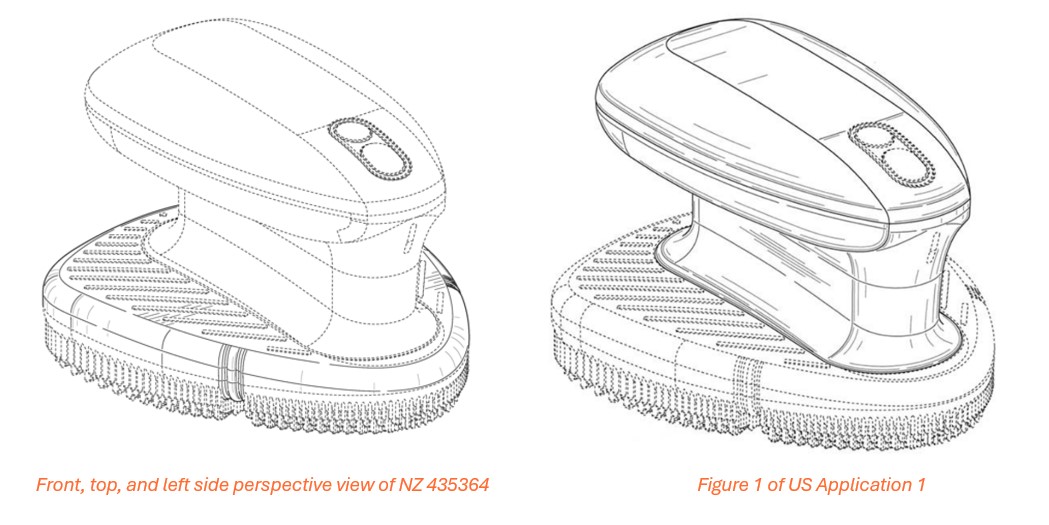
The proprietor filed two New Zealand design applications on the same day, each claiming priority from different US design patent applications filed two weeks apart. Although both related to the same grooming device, each claimed novelty in different features.
Assistant Commissioner Reeve found that design 435364 could not validly claim convention priority from the earlier US application (US Application 1) because there was no equivalence of scope: the features claimed as novel in the New Zealand application were disclaimed in the US priority document.
As a result, the earlier priority date was unavailable, and the design was considered not new or original because those features had already been disclosed in the earlier US filing.
Reasoning behind the decision
The Designs Act 1953 governs design registration in New Zealand.
Under section 5(2) of the Act, “a design shall not be registered unless it is new or original and in particular shall not be so registered in respect of any article if it is the same as a design which before the date of the application for registration has been registered or published in New Zealand…”
Assistant Commissioner Reeve adopted a conjunctive reading of this provision, treating “new or original” as a separate and independent requirement from “published or registered in New Zealand.” Drawing on the Onesteel decision, he reasoned that the prior art base for assessing the “new or original” requirement is not limited to designs formally published or registered in New Zealand, but can include other accessible documents – such as unpublished foreign filings.
Critically, US application 1 was not published but became accessible only because a certified copy had been placed on the IPONZ register for the related New Zealand design application (435363) as part of that application’s convention priority claim. Reeve held that this accessibility was sufficient to establish the design as prior art for the purposes of the “new or original” requirement, even though US Application 1 was neither “published” nor “registered" in New Zealand within the ordinary meaning of those terms in section 5(2).
This aspect of the decision may be revisited if challenged on appeal.

Chapman Tripp Patents’ comments
The decision reinforces the key point that registration does not guarantee validity: a design must be new or original at the date of registration. Interested parties may apply to cancel a registration, including on the ground that the design was not new or original at the date of registration.
The case also highlights that convention priority requires equivalence of scope between the priority document and the New Zealand application – a critical consideration when filing design applications claiming foreign priority.
The message of the decision is therefore clear: convention priority requires consistency in what is claimed as novel (solid lines) and what is disclaimed (dashed lines). Filing multiple applications for the same article with different solid and dashed line configurations will not secure valid priority unless each New Zealand application is supported by a corresponding priority document of matching scope. Thorough due diligence before filing is therefore essential.
Chapman Tripp Patents is here to help navigate these complexities in New Zealand.