Contents
This was expected to be a lull year for the Reserve Band of New Zealand (RBNZ), some breathing space between the high-level policy formulation of 2024 and the detailed exposure draft consultations planned for 2026. Instead, the RBNZ has stayed in spin cycle.
Significant change at the RBNZ
Adrian Orr’s departure in March was unexpected and abrupt. Dr Anna Breman has just been announced as the new long term Governor, 200 days later. In the meantime Christian Hawkesby’s appointment, first as acting then as temporary Governor, saw already him at the wheel through the historic commencement of the Depositor Compensation Scheme and the bulk of the new capital review (discussed previously).
However the economy remains in difficulty and there is increasing (and increasingly public) political pressure on the RBNZ – from the recently released Select Committee Report to the RBNZ Chair’s resignation. The present capital review shows a willingness for the RBNZ to change course, including in some surprising ways. It may seem a small thing that RBNZ is willing to work with Australasian Performing Right Association Limited (APRA) to produce new regulatory capital requirements that fit with Australia’s regime, and to facilitate a ‘single point of entry’ Australian-led resolution approach. But these changes are a considerable reversal from the status quo.
Despite the memorandum of understanding between RBNZ and APRA, local policy had previously valued New Zealand bank self-sufficiency, and the ability to resolve New Zealand’s banks domestically. Acknowledgements that we may need to integrate with the Australian system, or even rely on them in a banking collapse, are difficult to reconcile with this. This more open mindset is likely to filter through into the ongoing development of deposit taker standards under the Deposit Takers Act 2023 (DTA), that will set the tone for New Zealand’s banking system for the foreseeable future.
Of interest will be whether this iconoclasm could relax New Zealand’s restrictive branch rules (a measure potentially implicit in the Select Committee Report), given that two smaller banks have announced full exits from New Zealand in the last 18 months and that HSBC has exited from personal banking in the New Zealand market. (See our commentary here).
The announcement of Dr Anna Breman as long term Governor may allow the RBNZ to start rebuilding. But the tight-rope walk to balance elevating competition without fundamentally compromising the RBNZ’s core financial stability mandate (or its independence from Government) will continue.
Increasingly weighty bank supervision
Both the RBNZ and the Financial Markets Authority (FMA) are ramping up the intensity of their supervision.
The RBNZ is moving toward the hands-on stance taken by prudential regulators in Australia, the UK and other large economies. To some extent this is driven by the strengthened incentives the Depositor Compensation Scheme creates to prevent bank failures and any resultant cost from an explicit government guarantee. We think it will continue despite the fact that it is resource-intensive and the RBNZ is now having to work within a tighter budget and smaller headcount.
More detail on the RBNZ’s future on-site supervisory strategy is expected soon. The central bank has already signalled that it is considering the scope of the powers granted under the DTA in planning its new approach to information-gathering.
The FMA is working through equally dramatic changes as it gears up for its new responsibilities, specifically:
- the Conduct of Financial Institutions regime that came into force earlier this year
- the shifting of consumer credit regulation to the FMA, including on-site supervisory responsibility, with submissions now closed on three financial services bills (see Chapman Tripp commentary here).
The FMA has responded with a new Outcomes-Focused Regulation framework, featuring more frequent and intense supervisory interactions, particularly for larger businesses, along with more engagement with boards and senior management.
Banks and other deposit takers will need to learn to live with, and manage relationships with, more inquisitive primary regulators with broadly overlapping mandates and duplicative powers.
Overbearing timing pressures
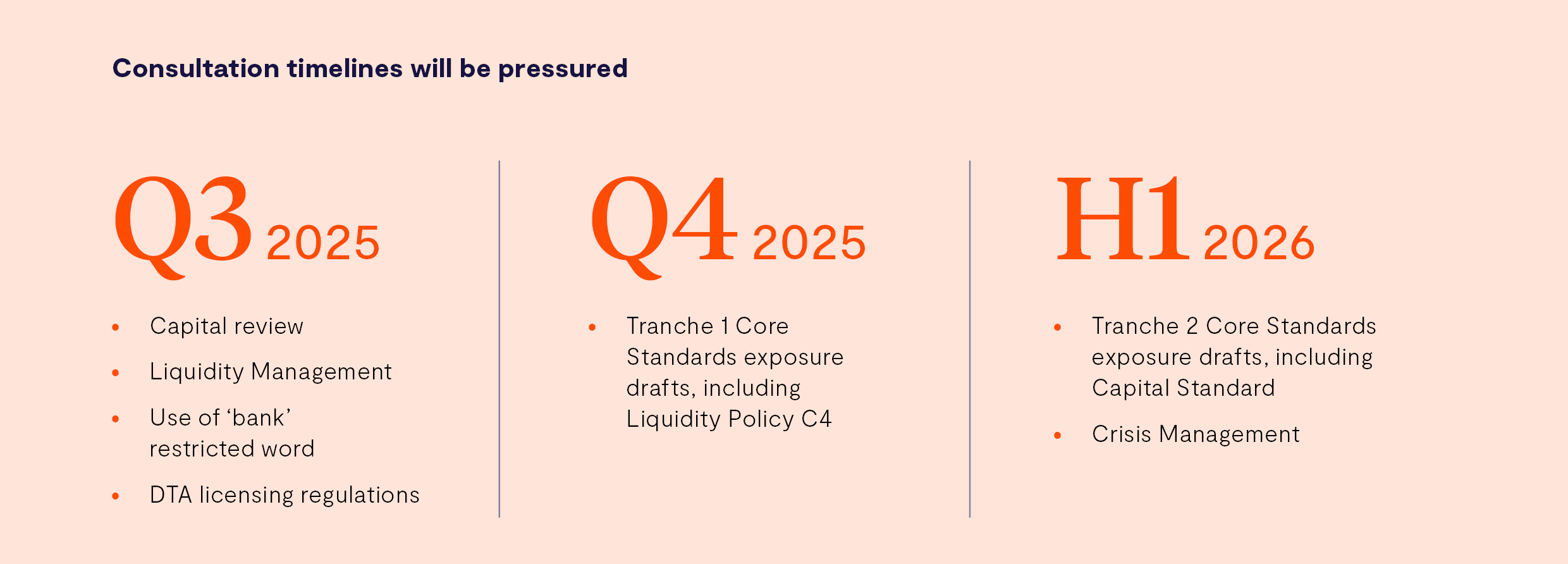
The deadline to full implementation of the DTA keeps ticking down with the RBNZ under timing pressures to achieve its work programme by the time licensing starts in 2028 – and a legislated 2029 backstop means they cannot substantially delay.
In addition, DCS and Credit Contracts and Consumer Finance Act 2003 (CCCFA) licensing are also to be achieved this year and 2028 will roll around soon enough for the DTA.
When the regulatory calendar of the Council of Financial Regulators (CoFR) was first published in 2022, it generally fit on about three generously spaced, portrait pages. In 2025 it takes seven landscape pages of tightly packed rows.
For deposit takers this will mean that both consultations and implementation will be pressured and jammed in wherever they can be.
CoFR’s nominal ‘no fly zone’, which seeks to avoid consultations over the December/January holiday period, is regularly honoured in the breach – this year it includes a consultation on tranche 1 of RBNZ’s core standards. Similarly, the implementation of both open banking and the 2028 DTA changeover are scheduled for December, when banks are generally in ‘change freeze’ to mitigate risk of error when available resource is naturally at its lowest.
Walking the regulatory perimeter
Given its workload, resource, budgetary and other constraints, we don’t expect the RBNZ to extend its focus to entities beyond its current mandate for the foreseeable future. This will create a low-oversight opportunity for the already fast-growing private credit and shadowbanking markets – especially those that do not take deposits and are therefore historically less likely to impact financial stability.
Longer term, we expect the RBNZ will follow the international trend among financial sector regulators and sharpen its oversight of new and developing market sectors. There is precedent for this in the RBNZ’s ‘future of money’ work programme.
The FMA is also aware that it is walking a regulatory perimeter, as Chair Craig Stobo has acknowledged, saying they need to ”make choices about where to focus our limited resources to best fulfil our statutory objective”.
We expect this to include continued work in the fintech and private credit spaces, similar to other international regulators, including the Australian Prudential Regulation Authority (APRA), as well as ongoing attention to the use of wholesale offer formats.
This article is part of our regular publication The banking industry: A look ahead. Read the other articles in this series below.