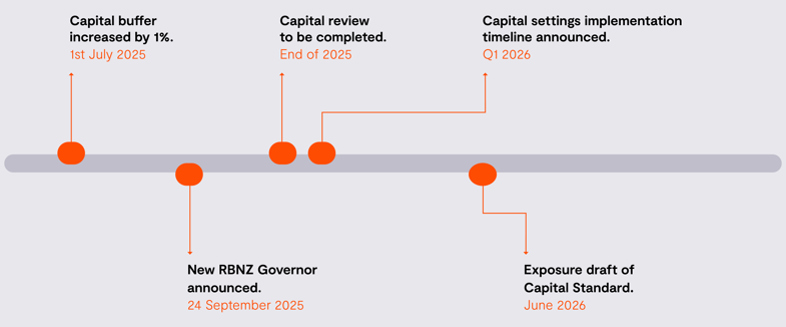
As banks adapt to systemic changes across their entire balance sheet, divining where the new equilibria will settle for bank capital, assets and liabilities (in particular, funding) will require best guesses and no shortage of luck.
Certain long-term trends appear obvious, but the short and medium term are considerably more volatile – especially as external factors are exerting an outsize influence, from unexpected domestic regime changes to international politics.
Funding uncertainty
Deposit funding is the core building block for traditional banking and the maturity transformation it provides (accepting deposits that are often repayable without notice, and lending on longer fixed terms). It is also historically cheap.
However, reliance on deposits has increased significantly over the last decade. According to RBNZ data, it shot up to 90% of bank funding during COVID (from around 85% previously) and has remained elevated ever since.
Deposits contribution to banks’ core funding ratio
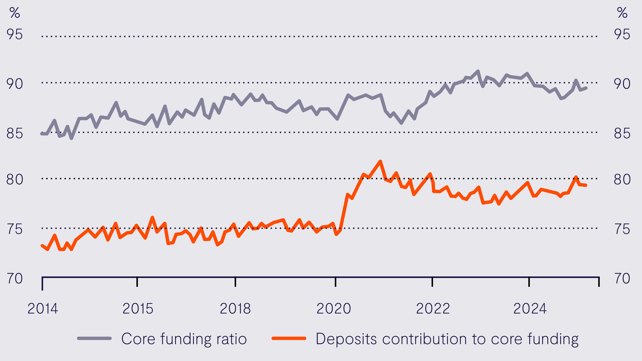
Source: RBNZ Liquidity Survey and RBNZ Financial Stability Indicators, September 2025
That may reflect increased depositor confidence in the new Depositor Compensation Scheme - a truly fundamental development that was almost unimaginable (and fiercely rejected) in New Zealand ten years ago. It may also be an indicator that other funding sources have become more difficult to source. Increased Government borrowing since COVID, for example, has upped the cost of borrowing in the local market.
Despite these uncertainties, we expect a continuing focus on diversified funding sources across both capital market funds and deposit bases. This will be driven by factors discussed elsewhere in this publication (and in previous publications) including:
- a combination of open banking and deposit insurance broadening competition for deposits. As RBNZ Assistant Governor Karen Silk has noted:1
“… funding risks have evolved since the GFC. It is now not only large financial institutions that have the awareness and the means to move their money at short notice.”
- a public focus on deposit returns. This is already playing out overseas, most notably in the United States (where the 2023 mini-crisis reminded depositors of banking risk), and high yielding bank accounts are becoming more common. Capital One recently agreed to pay US$425m in settlement of claims that their customers should have been told that they could move their money to higher-yielding accounts.2
More than ever, bank treasury must be well-prepared and ready to go in multiple formats, in multiple markets, at a moment’s notice. To obtain funding at good prices will also engage a measure of luck as more and more we are seeing markets close without warning.
There are also some destabilising factors at play: isolationist policies may direct or restrict capital flows, the international and cross border settlement infrastructure is changing, and digital assets may become more mainstream under President Trump. New Zealand issuers will need to keep up.
Strong deposit bases will inevitably be valued for the buffer they provide against the whims of the market.
Asset base uncertainty
At the opposite end to the “anti-woke banking bill” and its proposed restrictions against an ESG lens to lending, we expect various changes at a regulator and political level to direct lending towards (or away from) certain sectors. This includes:
- the capital review (discussed above), which will change the risk weightings applied to various forms of lending (and therefore their cost and appeal to lenders), and
- interventions such as the loan guarantee scheme the Government is currently exploring to promote bank lending in support of community housing.
Moving beyond lending, we expect further consideration of banks’ liquid asset portfolios. Although liquidity changes are likely to continue to encourage Government Bond holdings, the risks of pricing dislocations between treasury and swap markets have been emphasised by Liberation Day.