Contents
The Overseas Investment (National Interest Test and Other Matters) Amendment Bill has emerged from the select committee with only two ‘headline’ amendments proposed - but some of the more technical changes, if proceeded with, may frustrate the Bill’s investor-friendly intentions.
Headline amendments
The Overseas Investment Office (OIO) will no longer be required to have regard to the purpose of the Act when conducting a national interest assessment, the committee having accepted that the Purpose Statement’s “multifaceted nature” could cause confusion for the regulator and practitioners.
To refresh: the Purpose Statement acknowledges that it is privilege for overseas persons to own or control sensitive New Zealand assets by:
- providing for notification or consent for any overseas investments in those assets before the investment is made
- imposing appropriate conditions on those overseas investments, and
- managing the risks to New Zealand’s national interest that are associated with overseas investment transactions, including national security and public order risks.
And all of this while “recognising the role of overseas investment in increasing economic opportunity by enabling the timely consent of less sensitive investments through an initial national interest risk assessment”.
We agree that the co-existence of the various objectives make the Purpose Statement difficult to apply but we consider a more sensible approach might have been to rationalise the purpose statement. In any event, the deletion is arguably of no effect given it is a fundamental principle of statutory interpretation that the words are construed in light of the Act’s purpose.
The other ‘headline’ amendment would remove “character and capability” from the non-mandatory factors the OIA might consider in assessing investor risk under the new national interest test. Two arguments are offered for this:
- it would “more clearly encourage the regulator to focus on the risks to the national interest of the transaction proceeding”, and
- the Government can direct the regulator to undertake criminal checks via a Ministerial directive letter should it so choose.
Character and capability of investors will continue to be assessed under the current investor test for investments not eligible for the new national interest test.
Big issues in the small print
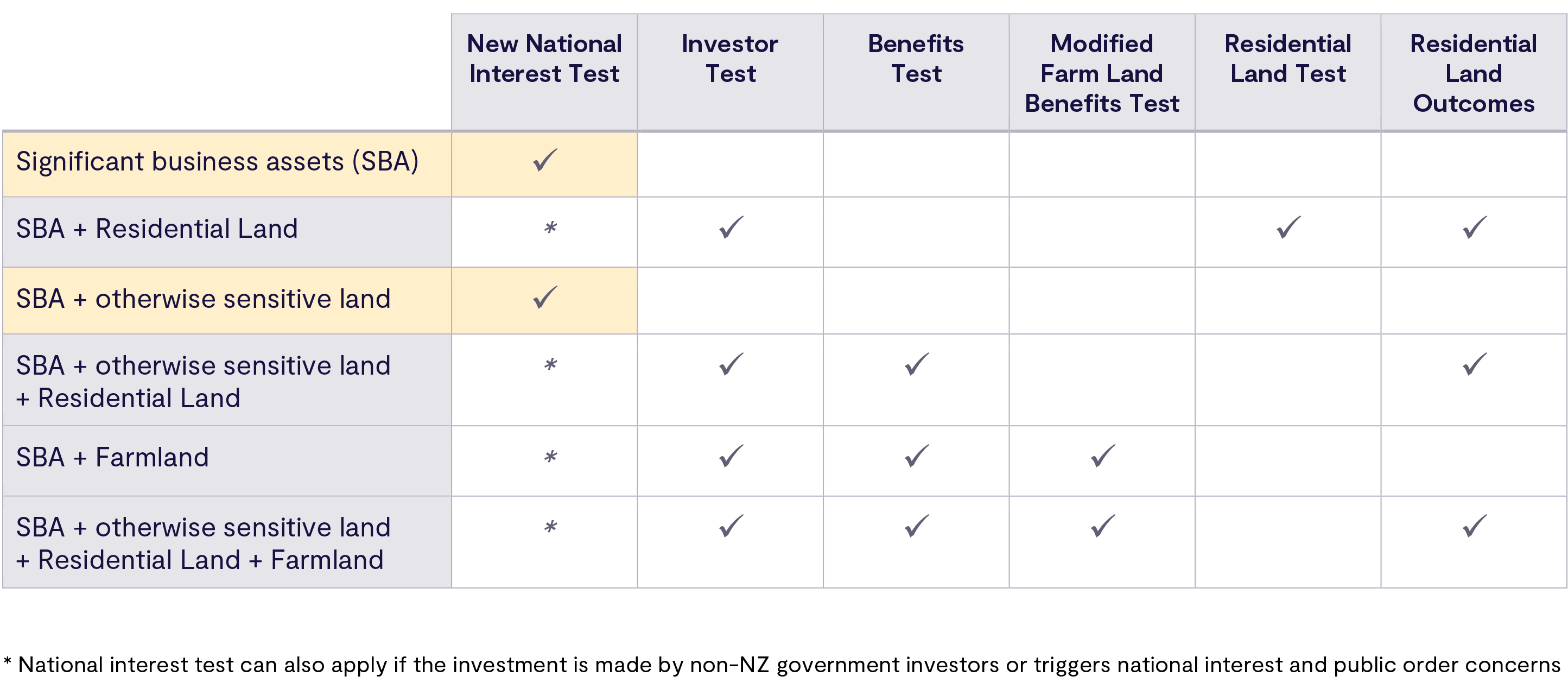
Our major issue lies in the “clarification” the committee is proposing to the test that applies for hybrid sensitive land/residential land transactions (see Clause 8 amendments to Section 16(1)(d) and (e)).
There are more favourable tests for transactions involving residential land and for otherwise sensitive land (the new national interest test) but when the two are combined, either in the same piece of land or in the same transaction, the transaction will be required to meet the benefit to New Zealand test. This will be very confusing to communicate (or justify) to potential investors.
Intuitively, applicants seeking consent for mixed land should be able to avail themselves of the simpler pathways that would otherwise apply to each category of land in isolation. This matters in commercial transactions where residential land is typically incidental to the deal and the applicant does not intend to use the land for residential purposes.
In those cases, an applicant should be able to obtain consent where it:
- does not intend to use the land for residential purposes, and
- satisfies the national interest test.
This is highlighted by the below example:
Chapman Tripp comment
In our commentary on the Bill’s introduction, we observed that the move towards an open-textured national interest assessment, affording Ministers more discretion to intervene, risked foreign direct investment being at the mercy of the government of the day to an even greater extent than it is today.
Far from solidifying a presumption in favour of foreign investment, and increasing investment certainty, the Bill will increase the scope for political intervention.
Next steps
There may be some scope to secure further change from the floor of the House during the committee stages of the legislation.
We note that the Government is already committed to an amendment allowing “golden visa” holders to buy or build one house in New Zealand provided it is worth more than $5m. The details of that amendment have not been released but are expected to only apply to residential land, not opening the door to otherwise sensitive land.
The commencement provisions in the Bill state that if it has not come into force three months after receiving the Royal Assent it will take effect on the first day of the next calendar month.